


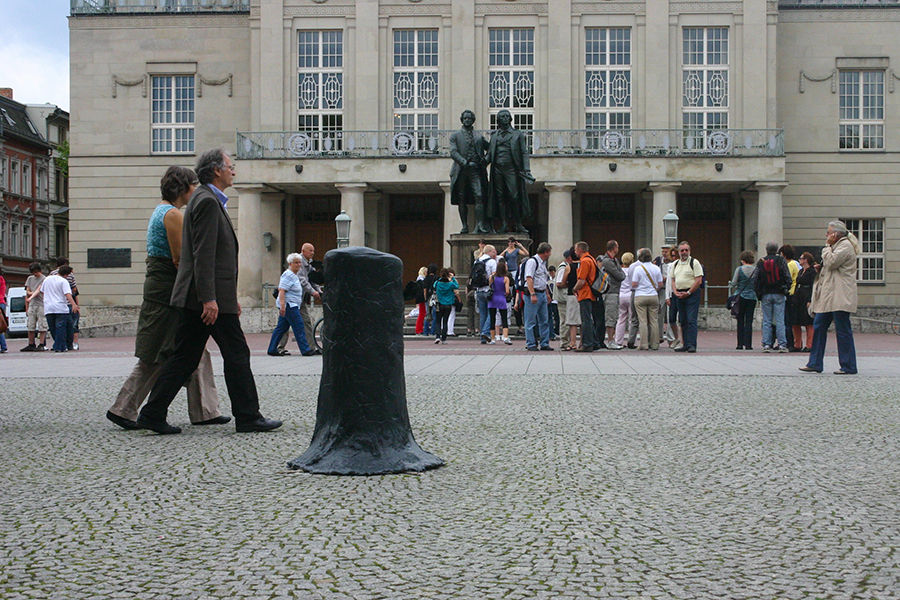

Baumstumpf
2009
Steel, metal, plaster, enamel paint /
Stahl, Metall, Gips, Emaillelack
105 × 60 × 60 cm
Theaterplatz, Weimar (DE)
Courtesy the artist
Der Theaterplatz in Weimar mit dem Deutschen Nationaltheater, dem Goethe-Schiller-Denkmal, dem Bauhaus-Museum und dem Wittumspalais ist das kulturelle Herz der Stadt. Seit 1857 steht hier das von Ernst Rietschel geschaffene Goethe-Schiller-Denkmal. Es zieht jährlich Tausende Besucher:innen an, doch viele übersehen den kleinen Baumstumpf hinter den Dichtern. Er wird von Goethes Bein verdeckt, ist aber von hinten als Eiche zu erkennen, ein nationales Symbol des 19. Jahrhunderts. Der Stumpf hat auch eine statische Funktion und stützt die beiden Figuren. Betrachtet man das Denkmal von hinten, sieht man, wie er mit den Gewändern Goethes und Schillers verbunden ist.
Nicolas Vionnet bildete den Baumstumpf nach und platzierte ihn mitten auf dem Theaterplatz – damit wollte er die Bedeutung dieses Elements unterstreichen und den Wahrnehmungsraum der Besucher:innen verändern. Was sonst unerreichbar hoch auf einem Sockel stand, wurde plötzlich greifbar und erlebbar. Mit dieser Strategie hob Vionnet nicht nur die Grenze zwischen Kunst und Betrachter:in auf, sondern hinterfragte auch die Funktion von Kunst im öffentlichen Raum.
The Theaterplatz in Weimar—with the National Theater, the Goethe-Schiller Monument, the Bauhaus Museum, and the Wittumspalais—is the cultural heart of the city. It has been the site of the monument to Goethe and Schiller, created by Ernst Rietschel, since 1857. The monument draws thousands of visitors each year, yet many overlook a small tree stump behind the two poets. Partially concealed by Goethe’s leg, the stump, seen from the back, can be identified as an oak tree—a national symbol in the nineteenth century. Beyond its symbolic significance, the stump also serves a structural purpose in that it supports the weight of both figures. From behind, one can see how it merges with the flowing garments of Goethe and Schiller.
Nicolas Vionnet replicated this overlooked detail and installed it right at the center of Theaterplatz—as if to draw attention to its significance and to shift viewers’ perceptual framing. What once stood unreachably high on a pedestal, suddenly became tangible and accessible. In doing so, Vionnet not only lifted the boundary between artwork and audience but also challenged the role of public art itself.